Showing posts with label Sewing. Show all posts

Sunday, December 24, 2017

Fast and Easy Dog Bow Tie

Happy Holidays!

If you are still looking for the perfect accessory for your dog for the holiday pictures, this may be the perfect project. If you use a sewing machine, you can have this done within 5 minutes. Even if you are not skilled at sewing - you can make this. All the stitching is hidden from view.


Needed materials:
Small amount of fabric - I usually just use a fat quarter, since this requires a small amount of fabric. 
Sewing Machine or Needle and Thread
Dog Collar or some other way to attach to your dog (ribbon, elastic, ties, clips, etc.)

Step 1: Cut two rectangles out of your fabric. 

Cut the large one double the size of what you want your finished bow tie to be, plus double the amount of the seam allowance. 
For example: This finished tie is 5.75" wide by 3.25" tall. I am using a .25" seam allowance. (5.75 + .25) x 2 = 12", (3.25 + .25) x 2 = 7". I cut the large rectangle 12" x 7". 

Do the same thing for the small rectangle. I cut mine 2.5" x 2.5" One side will be the width of the knot and the other side will be the length of the knot wrapping around the bow and the collar - or whatever you are using to attach to your dog. I attach my bow ties with elastic, so I do not worry about this too much. If you are going to attach yours to a collar, you may want to complete the bow and then come back to this step to cut the small rectangle to ensure it is long enough. Keep in mind, if you are using the type of collar that snaps shut instead of buckles, you will also need to be able to fit it over the snap at the end.


Step 2: Fold the rectangles in half lengthwise. The inside of the fabric should face you. Sew along the long edge.


Step 3: You will now have two tubes. Turn them right-side out. Lay them out so the seam is in the center and facing you.


Step 4: Fold the rectangles in half the other way. The side with the seam in the center should be facing you. Sew along the side edge.


Step 5: Turn them right-side out. All the stitching should be on the inside. Lay the large rectangle down so the seam runs through the center of the back. Pinch the center and pull a needle and thread thru the center a few times to hold it.


Step 6: Pull the bow through the small loop to make the knot of the tie. Make sure the seam of the knot is on the back side of the tie.


Step 7: Thread the collar or whatever you are using through the back of the tie. If the knot is sliding around, you may want to put a stitch or two through the back of the knot to hold it.

If you want to make fabric ties to tie around your dog's neck, you can follow the steps for the ties in this posting. Start with step 8.

I usually use .5" elastic to attach mine for a couple reasons. My dogs are very fluffy. If I attach it to their collars, the bow tie just gets buried under the hair. So, whatever I use to attach it needs to be very loose. It basically needs to just hang there so it doesn't get buried. Also, I just use mine for a quick picture. The bow ties are only on for a few minutes and then I take them off. The elastic makes this easy to slide off and on their heads. If you are planning on keeping the bow ties on your dog for a long period of time, it is best to use a collar and not elastic. You do not want your tie to get caught on anything and harm your dog.


Step 8: Let everyone admire your handsome dog!

Frankie was not in the mood to model this tie, so this is not a great picture. But I have made lots of these ties for other holidays. Here are a few pictures of the finished product.


Sunday, May 8, 2016

Fabric Toilet Paper Holder

I have a toilet paper problem in my house... Whenever I hang it on the holder, my cat decides that it is a toy and this is how it ends up.
This is the result of only a few minutes of her time. If I would not have taken it away, she would have shredded the entire roll. Because of this, I have been putting the roll on the back of the toilet. I have been doing this for years. I've tried different storage methods through the years, but the back of the toilet was the only thing that did not result in it being shredded.

A few years ago, I saw a fabric toilet paper holder at a craft sale. It actually was made to store 3 extra rolls and was to be used in homes with minimal bathroom storage. I thought it was a neat idea, but didn't think much about it. A couple weeks ago, I saw the same thing and I knew that something similar would be the solution to my shredding problem. I came up with this.

I do not sew very often or very well, so making this was quite a bit of trial and error. If you decide to make this, please read the entire post prior to beginning. I tried a few different things and changed it up as I went, so read through the entire post and then make necessary changes to yours.

Needed materials:
Fabric
Interfacing (optional)
Thread
Sewing machine (or needle if you want to do it by hand)
Scissors
Iron

Step 1:
Cut your fabric for the holder. I used fat quarters to make mine, so mine was about 18" long. I then made two strips that were 6.5"wide. Originally, I thought that I could make it reversible so I used two different fabrics. Once I started making it, I figured out that it would not be reversible, so I could have used the same fabric for both strips.
Step 2:
Cut your fabric for the ties or loops. I originally made this holder with ties, but later changed it to loops. I made four ties 14" x 2".
Step 3: Attach interfacing (optional). 
I used a fat quarter to make mine, so the fabric was pretty flimsy. I had some iron-on interfacing from another project, so I attached that to the backside of both pieces. I used a medium-weight because I already had it at home. I probably would have been fine using a light-weight. This step is not necessary, especially if you are using a thicker fabric.
Step 4: Sew the two pieces together.
With the right sides together, sew the two pieces together. I used the 1/2" marker on the sewing machine for mine, but I could have made the margin smaller. Like I mentioned, I am not skilled at sewing. 
Sew both long sides and one short side shut, but leave about a 3 - 4" opening on one of the short sides.
Step 5: Cut the corners
Cut off the corners of the sewn together pieces. Initially, I did not do this and it was bulky at the corners. 
Step 6: Turn right-side out.
Turn the piece right-side out. Use a knitting needle, pencil, screwdriver, or something similar to poke out the corners.
Step 7: Sew the end shut.
Sew the hole that you left open closed. I sewed mine as close to the edge as I could.


Step 8: Make your ties or loops. 
Fold your tie in half and iron it flat.
Flip the tie over, unfold it, and fold the two sides in to the middle crease. Iron the two sides down.
Fold the tie back together with the original crease. The tie should now be folded in fourths.
Unfold the tie at one end and fold down the top 1/4" or so. Iron that flat. You may need to iron the top again to keep it down.

Sew the short side with the folded edge and the open, long side of the tie. Sew it as close to the edge as you can.
Knot the ends that are sewn shut.

Step 9: Sew the ties to the holder.
Sew the open end of the ties to what will be the inside of the holder. I placed my ties about 1/4" in from the sides and about an 1" down from the top. I sewed it about 1/2" from the top. Do this for all 4 ties.

Step 10: Sew the two ends together to form the holder. I made three lines across to ensure that it held.

Step 11: Hang the holder!


I am not using mine to store extra rolls. But if you are, just tie the holder lower. You will have the current roll on top and the spare roll in the holder.
After I had this hanging up, I realized that ties were not necessary. I had made ties because that is what the one I saw at the craft sale had. But I decided that I just wanted to make loops instead of dealing with ties. I ripped out the top. Detached two of the ties and then cut it down to about 6.5". I sewed the other ends down to the inside of the holder.
Then, sew the two ends of the holder together.
Hang it from the loops!


I made this version over two weeks ago and I am happy to report that I have not had any shredded toilet paper incidents! I think this is going to be a keeper!

 Additional notes:

  • This will hold a toilet paper roll with a circumference of about 14". I know not all rolls are the same size. So if you buy the larger rolls, you will need to increase the length of the pieces.
  • If I was to make this again, I would make the strips for the ties/loops thinner. I would probably cut them to be 1" wide. This would result in a 1/4" wide tie instead of the 1/2" tie that I have.
  • You could leave the top open if you wanted. Just sew the ties or loops on, but then don't close the top. That would allow you to use larger rolls, but it will not hold the rolls as securely.
  • If you use the loops instead of the ties, keep in mind that I am not using my for storage, so it hangs pretty close to the top of the holder. If you are going to use it for storage, be sure to increase the length of the loops to accommodate the current roll.

If you decide to make one, be sure to share a picture! I would love to see it! I'm sure anyone who is more skilled at sewing than I am would do a much better job!

Thursday, August 7, 2014

How to Make a Safari-Themed Nursery Mobile

Last week, I made my nephew a safari-themed mobile. My brother had looked at a few on Etsy that he liked, but they were quite costly. He asked if I would be able to make one. It was super easy and it turned out pretty cute. The entire mobile costs less than $5 to make! Each animal costs less than $1 to make!

The past five days, I have showed you how to make a felt elephantliongiraffemonkey, and snake to hang from the mobile. Be sure to click on the links for the tutorials of each animal if you missed them. Today, I will show you how to make the actual mobile.


Needed Materials:
String, Ribbon, or Yarn
Dark Green Felt
Light Green Felt
Embroidery Hoop
Washi Tape or Ribbon
Small Washer


Step 1. The embroidery hoop comes with two hoops. Take the inside loop out and use that. I used a 12 inch hoop. If you want yours to be bigger or smaller, just adjust accordingly.


Step 2. Take your washi tape or ribbon and put it on your the inside of the embroidery hoop. I used washi tape because it was quick and easy. You also could glue a ribbon around it or even wrap yarn around the hoop. Being that it is on the inside, you really do not have to decorate it, but I think it looks nicer.


Step 3. Attach the main hanging string. Cut 3 lengths of yarn or string at about 8 inches (or the length that you desire). Tie these three strings to the washer and then to the hoop. Try to evenly space them around the hoop. I then put a small piece of washi tape over it to hold it in place. Cut a long length of yarn and tie it to the washer. The length of this piece depends on what you are hanging it from and at what height. 


Step 4. Make the felt leaves. I did not make a template to make these. I just cut them at random.


Step 5. Cut a length of yarn about 2 feet long. Starting from the bottom of the felt animal, pull the yarn though the animal. Depending on the weight of the felt animals, you may need to play with the placement. If your animal is too heavy on one side, it can cause the animal to lean to the side. If the animal is top heavy, it can fall forward or backward, so you may have to experiment. 


Step 6. Put a knot at the very end of the yarn. Pull the yarn through the animal until you get to the knot. The knot at the bottom of the animal will hold it. You may want to put a small dab of glue on the knot just to ensure it stays.


Step 7. Thread the yarn through the leaves. Again, you will want to place a knot at the bottom of each to hold them up. Put as many or as few leaves as you want. Do this process for all the animals.


Step 8. Tie the animals to the hoop at your ideal length. You may need to move the animals around or change the lengths of the yarn because you need to create a balance. Ideally, you should place similar weight items across from each other.


Step 9. Once you are sure of your placement of the animals. Put a small piece of tape or glue on the place where you tied it to the hoop. This will ensure that they don't slide around the hoop and become unbalanced.

Step 10. Place the washi tape or ribbon on the outside of the embroidery hoop.

Step 11. If you want an animal in the middle of the mobile, tie that animal to the washer.

Step 12. Hang the mobile and enjoy!


If you don't want to use a hoop, you can usually find an old mobile at the local thrift stores. You can follow the same process of hanging the animals, just hang them to the mobile holder instead of the hoop. Here is a picture of the felt animals that I made hanging from an old mobile hanger.


Another option is to take a couple dowels, glue them together to form a "t" and hang the animals from the dowels. This method does require more work to get the animals to balance. I did not try this method, but it would work if you have dowels on hand.

This would make a great personalized gift for any baby shower. Simply change the animals to fit any nursery theme. It is quick, easy, and inexpensive to make! 


Tuesday, August 5, 2014

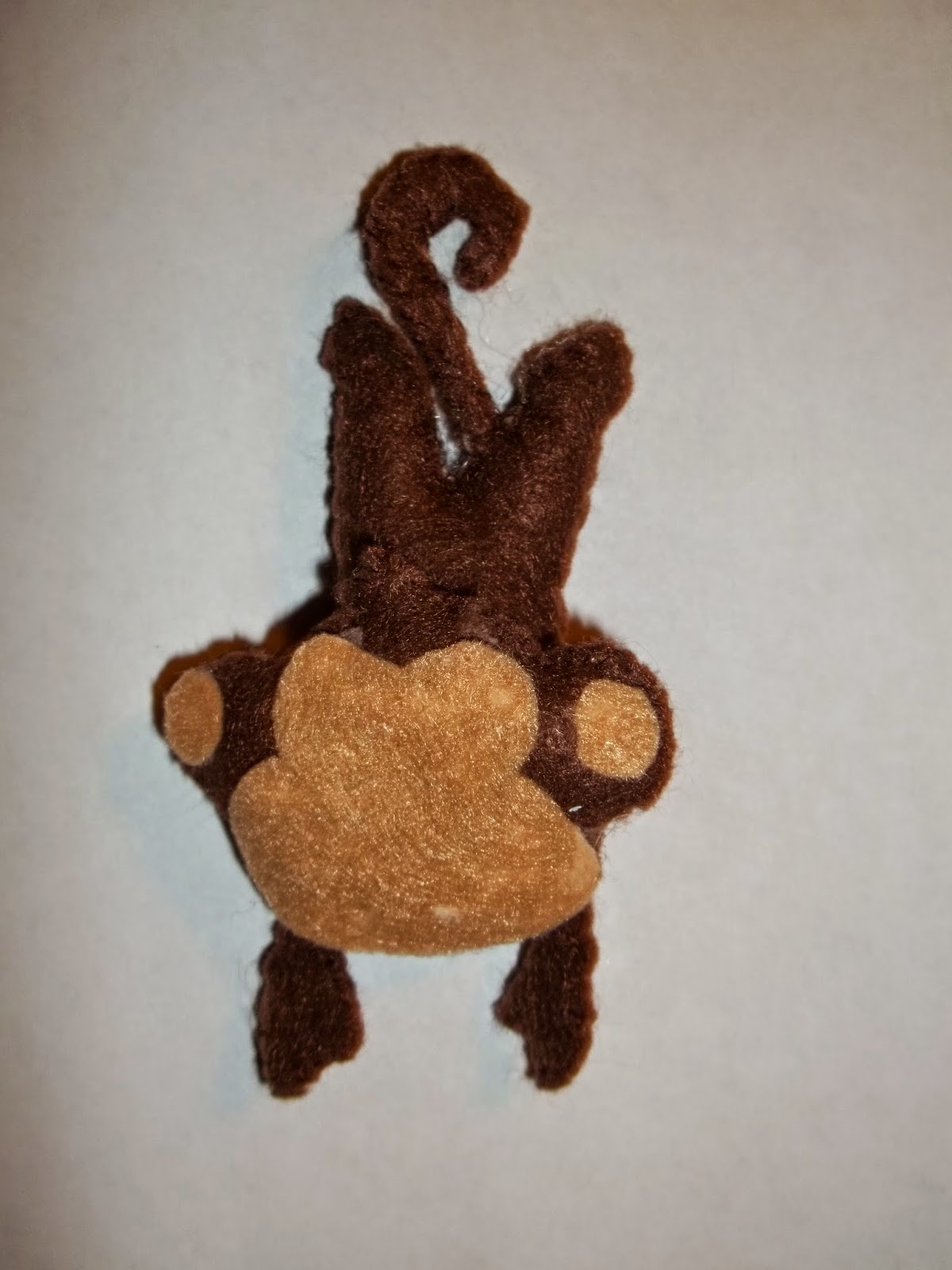
How to Make a Felt Monkey Toy

Last week, I made my nephew a safari-themed mobile. My brother had looked at a few on Etsy that he liked, but they were quite costly. He asked if I would be able to make one. It was super easy and it turned out pretty cute. The entire mobile costs less than $5 to make! Each animal costs less than $1 to make!

Today, I will show you how to make the monkey. I made mine basic colors, but you can make yours any color that you want.


Needed Materials:

Dark Brown Felt (body and head)
Light Brown Felt (face and inner ears)
White Felt (outer eyes)
Black Felt (inner eyes and nose)
Small Amount of Polyfill Stuffing
Sewing Needle
Thread
Craft Glue


Step 1. Make a template. I looked through several clip-art monkeys for ideas and then drew up a template. I am not artsy at all, so you may want to come up with your own ideas. Here is pdf file of the monkey template that I used.


Step 2. Using your template, cut the monkey body, head, face, and inner ears out of the felt. I did find that it was a little easier to cut out the template if I pinned the template to the felt and then cut around it.


Step 3. Staying close to the edges, sew around the entire body. Be sure to leave an open space to put in the stuffing. 

Step 4. Lightly stuff the monkey's body.

Step 5. Once you are happy with the amount of stuffing, sew the hole shut.

Step 6. Follow the same process for the monkey's head.

Step 7. Sew the monkey's head to the body.


Step 6. Glue or sew on the face, nose and inner ears.


Step 7.  Glue or sew on the eyes. I did not make a template for the eyes, because they are just ovals. However, you might choose to use safety eyes or googly eyes or whatever you want.


Step 8. Make the mouth. I just drew on the mouth with a Sharpie, but you could also embroider it or even make it out of felt.


I think this monkey turned out pretty cute. These felt animals would also make great toys or even decorations. You could also skip the stuffing and use them as embellishments.

So far, we have made an elephant, lion, giraffe, and monkey. Tomorrow, I will show you how to make the snake.